
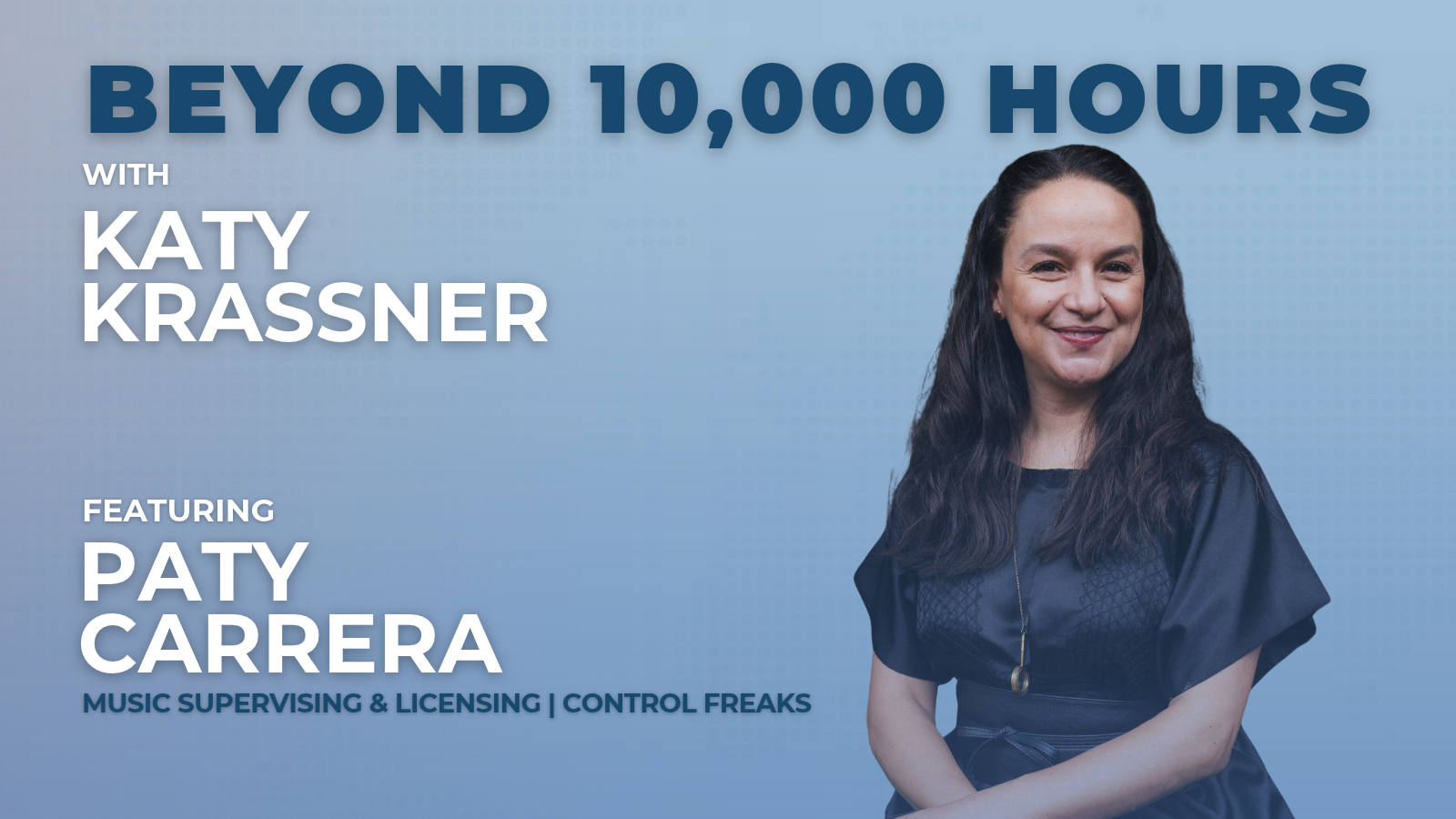
And I’m just dreaming
I grew up in Mexico City in the south of my city. My parents were really musical, and they both played guitar. My mom was especially talented and was part of a notable music ensemble in college. Growing up, there was always music and art around our house. I gravitated toward dance, and when I went to college, I did all the musicals. Although I loved it, I realized that I wasn’t going to make a living at it.
I decided to jump into something else, but I didn’t know what. Not long after, I saw an advert on my university’s job bulletin board from the Sociedad General de Autores y Editores/SGAE (General Society for Authors and Publishers, the official Publishing Rights Organization of Spain). I’ll be honest, I thought the job had something to do with working with authors and their books! I had no idea what a PRO was. During the interview I thought, they’re never going to hire me because I know nothing about this. I was so surprised when they offered me the job. The main reason was that they wanted someone with almost no experience, and I certainly fit the bill!
It’s time for me to take it, I’m the boss right now
When I was at SGAE and working with their members on understanding things such as publishing, royalties, rights, improving their metadata, etc., I realized two things. 1) It was very complicated and 2) Understanding publishing was not something musicians typically taught themselves. After three years at SGAE, learning everything I could, a colleague, Sophie Moghrani, and I felt confident enough to start our own business, Control Freaks. Our original goal was to help composers and performers collect royalties. Later, Sophie decided to switch industries, and I kept the company. About 16 years ago, my sister, Alejandra, joined me. Now Control Freaks fulfills many services: music supervision for movies, television shows or commercials, music editing, music coordination, on-set supervision, research on licenses and more.
Three of our clients – Mexican singer-songwriter Ely Guerra, Beto Cuevas, the Chilean singer songwriter and lead singer of La Ley, and the Mexican indie rock band Enjambre – have been with me for over 24 years! Sometimes the artists we work with become family, like legendary producer Phil Vinall, who passed away in December. He was a Brit who moved to Mexico and changed the indie rock scene in Ibero America, producing some of the biggest bands from Argentina, Guatemala, Costa Rica, Ecuador, Spain, Colombia, and more. With Phil, we became involved in all aspects of his business and also became his family.
Would you capture it or just let it slip?
There are three big moments I think really defined my career (so far!).
1) I started to work on documentaries with Carlos Hagerman. Working on documentaries is unique in music supervision. They typically have low budgets and the songs chosen for licensing are sometimes really hard to track down. Working with Carlos taught me how to do really deep research on names and rights holders. It was an invaluable experience.
2) My good friend Gimena Bárcenas was working in advertising and a director she met asked her to do music supervision for one of his projects. She didn’t want to do it alone, and since I had already done licensing for tons of projects, we did it together. The film was very complicated. There were actors singing and dancing, bespoke music, special collaborations, a score, songs written specifically for the movie, etc., so there was a lot of work to be done. It turned out to be really great training.
3) A few years later, a film producer named Martha Sosa, who I had met through Carlos, was preparing a really big movie. Her usual Supervisor was unavailable, so she came to me. The movie was called Cindy La Regia and it was an incredible film to be a part of. That was the moment that I felt I had stepped onto a bigger stage, and large projects started to come my way.
People seem to think Music Supervisors are competitive with each other, but a few years ago, myself, Gimena Bárcenas and Samantha Parvin started a WhatsApp group chat with other music supervisors. We felt it was important to connect and also make our jobs easier by sharing information with one another. We met up at FIM/Feria Internacional de la Música Professional (International Music Fair), one of the most prominent music conferences and showcase festivals in Latin America, and La Asociación de Supervisión Musical de Habla Hispana (or ASM) was born. I was voted President, and now we have over 60 members. Our Association represents music coordinators, music editors, music supervisors, catalogues, tech companies and more. And coming full circle, the VP of the Association is Martha Fritz, and her father Antonio hired me for that first job at SGAE!
Open your eyes and look at the day
I go to a lot of festivals; in fact, I will be at VIFF (Vancouver International Film Festival) in October. Last year was my first time going, and this year they invited me back to participate more. I am doing one panel, an interview, and I will go to showcases and listening sessions. When artists come up to me at music festivals to pitch me music and they’re not registered with a PRO…well they’re not sync ready.
I do try and offer advice to young musicians because I know how confusing this part of the business can be. In fact, I actually started an educational and networking program focused on exporting music through sync with Enzo Massardo, who runs music education for ASM. The Advanced Sync Program has been adopted by many countries like Colombia, Chile, Spain, Canada, Belgium, and more.
When you send a supervisor music, you need to be very clear about everything. We receive many songs and may not always have time to listen right away, but we save everything. Music with all the correct information has an edge.
^ Describe exactly what it is you’re sending: what type of music is it?
^ What type of scene would it fit into? What “mood” is the song?
^ What instruments are used on the track?
^ Who are the rights holders? PRO? Include meta data information.
^ Send links that never expire.
^ What other songs or acts does your track resemble? If we get a request for a XXX sound-alike when the production can’t afford a XXX track and your submission says, “Sounds like XXX.” I am going to call you (if you’re right)!
^ I also really appreciate consistency, so if you reach out monthly with new music, I will come to expect it.
I worked on an advertising campaign that was huge in terms of the license fee. It gave the artist a chance to go global, but he wasted it. He didn’t follow up, he didn’t read the metrics, he didn’t check on the other countries where the commercial aired. He didn’t make the most of all the opportunities offered to him.
I always recommend artists look at the big picture: the income from a sync is the tip of the iceberg. For a small artist, the fee is really useful and IF they are savvy in their royalty collection it can become something much more. Artists have to pay attention to everything and not rely on someone else to do it for them. I always tell musicians to have their own website and not just social media. Channels. You have much more control with your website. Artists must be reading their metrics- streaming, social, website. Where are the people hearing your song?? A smart artist will build strategies around that information.
Want to reach Paty and send her music?
Contact PatyInstagram: @patycarreramWebsites: www.controlfreaks.com.mx / www.patycarrera.comSpanish-Speaking Music Supervision Association: www.supervisionmusical.org
Did you know you can send your music for sync consideration with Caster+?
Submit songs to music supervisors plus radio, media, brand curators and other verified industry contacts with the click of a button. Learn more and sign up today.